Anthropic recently released a report identifying which jobs AI will most likely replace, with finance ranking prominently on that list. But AI doesn't simply eliminate roles — it transforms what those positions require. Teams that fail to adapt will fall behind.

The People
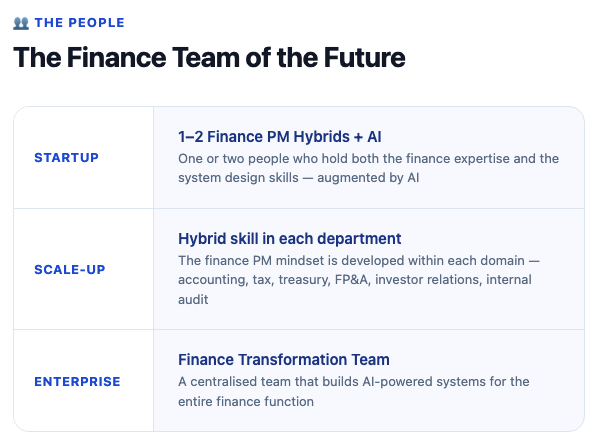
The modern finance professional must combine product management skills with financial expertise. A finance PM doesn't just execute month-end closings; they design the systems that enable them, considering data inputs, outputs, failure points, and testing protocols. They can brief AI coding tools similarly to how they'd specify requirements for developers.
This skill applies across all finance domains: accounting, tax, treasury, FP&A, investor relations, and internal audit. Implementation varies by company stage:
- Small companies: One or two AI-native builders can accomplish what previously required larger teams
- Scale-ups: Each department needs its own finance PM
- Enterprise: A centralized finance transformation team serving the entire function
The Tools
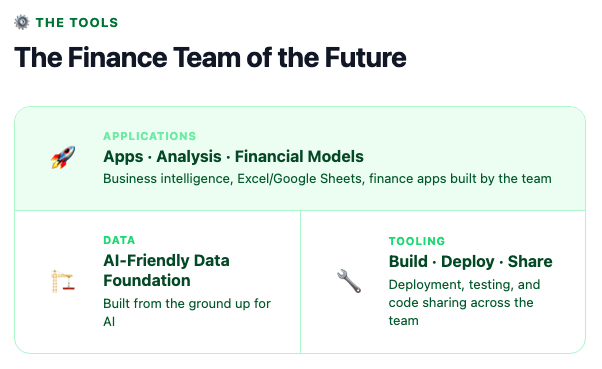
Proper tools are essential, yet most finance platforms weren't designed for AI integration. The foundation must prioritize AI-readable data built from scratch — not retrofitted or patched. This requires a single source of truth, consistent definitions, and clean data lineage.
Beyond data infrastructure, teams need tools for analytics building, model creation, application development, deployment, testing, and code sharing. Finance departments should own these tools as engineering teams own their technical stacks.
Block built a custom LLM called Goose that enabled finance and product teams to build and automate processes. Block's CFO credited 18 months of preparation for the confidence to restructure operations significantly.
Finally, there must be a product roadmap determining build priorities, sequencing, and departmental integration — ensuring continuous improvement across all finance functions simultaneously.